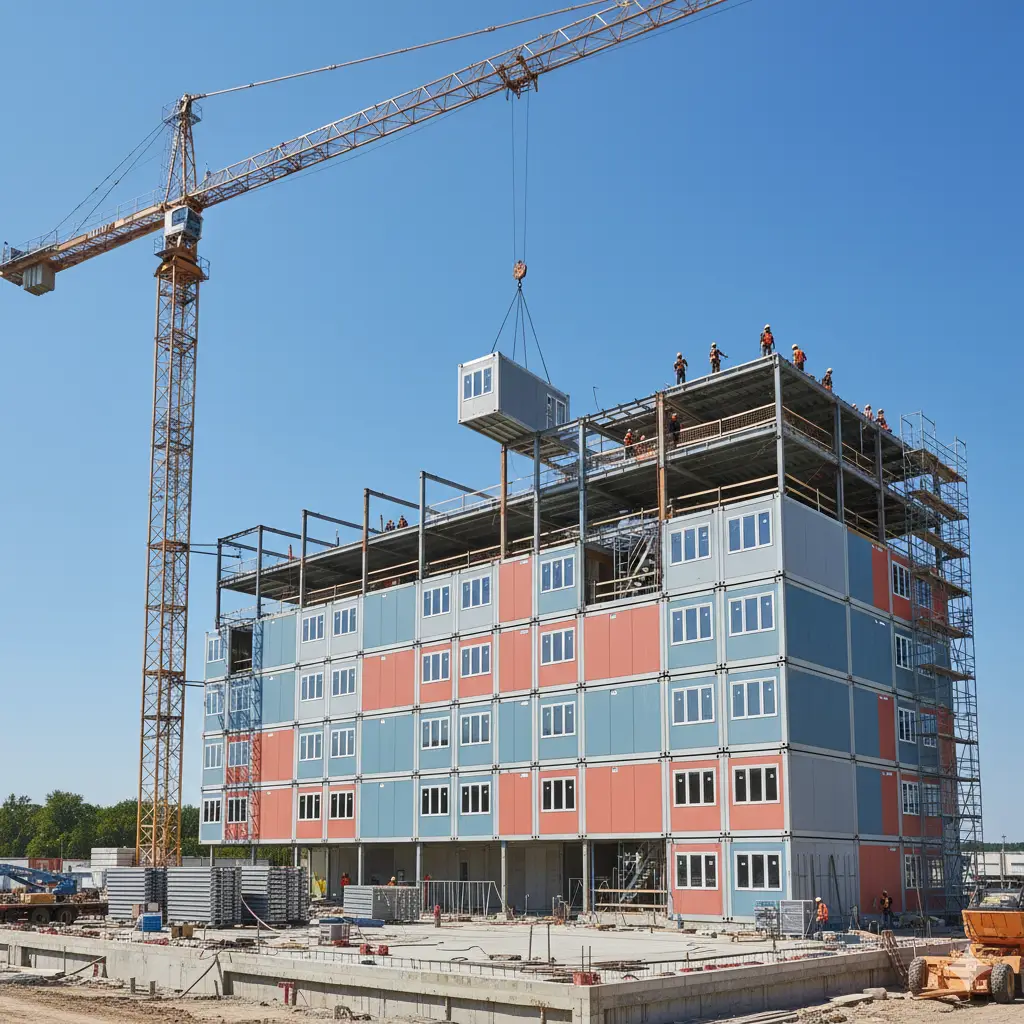
“Discover the incredible story of Broad Sustainable Building’s 10-story hotel, built in just 28 hours. Explore the revolutionary prefabrication technology that is changing the face of modern construction and addressing sustainability challenges.”
The Skyscraper That Rose in a Day: Is 28-Hour Construction the Future?
In the world of construction, where projects often span months, if not years, a story emerged that seemed to defy the very laws of time and labor. A 10-story building, fully assembled, in just 28 hours and 45 minutes. The claim, made by a Chinese company named Broad Sustainable Building (BSB), sent a ripple of disbelief and fascination across the globe. How could a feat of such magnitude be accomplished in less time than a weekend? Was it a marketing stunt, a hoax, or a genuine revolution in how we build? The truth, as is often the case, is more nuanced than a headline, but it offers a powerful glimpse into a future where the impossible might just become routine.
The building in question, the Ark Hotel, was a proof-of-concept project designed to showcase BSB’s groundbreaking modular and prefabricated construction methods. It wasn’t just a skeleton of steel and concrete; it was a complete structure, with interior finishes, plumbing, electrical wiring, and windows. To understand how this was possible, we must first abandon our traditional notions of construction. This wasn’t about pouring concrete and laying bricks on-site. This was the culmination of a manufacturing process, a paradigm shift from building to assembling.
The Secret: From Construction Site to Assembly Line
The cornerstone of BSB’s approach is prefabrication. Instead of constructing the building from scratch at the final location, the vast majority of the work—around 95%—is completed in a factory environment. The company manufactures self-contained, standardized modules that are essentially pre-made rooms or sections of a building. These modules are complete with walls, floors, ceilings, and even internal components like air ducts, electrical conduits, and plumbing pipes. They are built with a high degree of precision and quality control, far exceeding what is typically achievable on a conventional construction site.
This factory-based process offers several critical advantages. Firstly, it is not subject to the whims of weather. Rain, snow, or extreme heat, which can cause significant delays in traditional construction, are non-issues. Secondly, it allows for a highly controlled and optimized production line. Workers are not scattered across a sprawling, muddy site; they are focused on specific tasks in a clean, safe, and efficient environment. This not only speeds up the process but also drastically reduces waste. Materials can be measured and cut with machine precision, and leftover scraps can be recycled on-site. The manufacturing process itself becomes akin to building a car or an airplane, where every component is meticulously crafted and inspected before it is integrated into the final product.
The prefabrication stage for the Ark Hotel took months. This is a crucial detail that often gets lost in the headlines. While the on-site assembly was completed in under 29 hours, the entire project timeline from initial design to final assembly was much longer. The 28-hour claim refers specifically to the time it took to lift, place, and connect the prefabricated modules on the prepared foundation. This is where the true magic of the process lies.
The On-Site Symphony: A Dance of Cranes and Modules
The on-site assembly was a spectacle of choreographed efficiency. Once the modules arrived at the site, they were stacked one on top of the other, like giant, industrial-scale LEGO blocks. Cranes hoisted each module into place with remarkable speed and precision. Teams of workers on each floor were ready to immediately connect the modules, bolting them together and linking the pre-installed systems.
This process is where the inherent genius of BSB’s design becomes clear. Because the modules are standardized and pre-wired, the on-site work is minimal. There’s no need to run complex new wiring or plumbing; it’s a matter of connecting a few key points, much like plugging in a power strip. The structure is built with a steel framework that provides the core strength, and the modules slot into place within this framework. This design not only allows for rapid assembly but also ensures the building’s structural integrity.
The logistical coordination required for this to work is staggering. Every module must arrive on time, be in the correct order, and be free of defects. The cranes and operators must work in perfect sync. Any delay or error at this stage would have a cascading effect, slowing the entire process down. The 28-hour feat was a testament not just to the technology but to the rigorous planning and military-like execution of the BSB team. It was a live performance, a showcase of what a well-oiled, highly efficient system could achieve.
Beyond Speed: The Case for a Greener, Safer Future
While the speed of construction is what grabs headlines, BSB and other proponents of modular building point to far more significant benefits. At the forefront is sustainability. The factory-based process drastically reduces construction waste, which is a major environmental problem. Furthermore, BSB’s buildings are designed to be incredibly energy-efficient. The Ark Hotel, for example, was built with a thick thermal insulation layer and quadruple-pane windows, which BSB claims makes the building 5-6 times more energy-efficient than a traditional structure. This focus on insulation and airtightness minimizes the energy needed for heating and cooling, dramatically reducing the building’s carbon footprint over its lifetime.
Safety is another key advantage. Traditional construction sites are notoriously dangerous. Workers are exposed to heights, heavy machinery, and constant hazards. By moving the majority of the work into a controlled factory environment, BSB significantly reduces the risk of accidents. The on-site work is limited to the relatively simple and low-risk task of assembly, rather than complex and dangerous construction.
Furthermore, these buildings are designed to be more durable and resilient. BSB claims its modular buildings are earthquake-resistant, a crucial feature in a seismically active country like China. They are built to withstand a magnitude 9 earthquake, a claim that has been backed by independent testing and analysis. This is achieved through the steel frame and the way the modules are interlocked, which allows the structure to absorb and distribute seismic energy.
The Doubters and the Skeptics: A Critical Look
Despite the impressive claims and the undeniable visual evidence of the rapid assembly, the BSB project was met with its share of skepticism. The primary criticism centers on the 28-hour figure itself. As mentioned, this timeframe only accounts for the on-site assembly. The manufacturing of the modules took months beforehand. Critics argue that presenting it as a “28-hour build” is a misleading simplification that sensationalizes the process and ignores the extensive pre-work.
There are also questions about the long-term durability and aesthetic appeal of modular buildings. While BSB’s claims are backed by data, a mass-produced, standardized look can be a turn-off for some. The buildings lack the unique architectural flourishes and character of a custom-built structure. In a world that values individuality and bespoke design, the cookie-cutter approach of modular construction might struggle to gain traction, especially for high-end residential or commercial properties.
Another concern is the sheer logistical complexity of transporting massive modules from the factory to the construction site. This limits the scale and location of such projects. A 10-story building’s worth of modules is a significant undertaking to move, and the process would be far more complicated for a 50- or 100-story skyscraper. While the technology is impressive, its scalability to all types of construction remains a key question.
Finally, there are the socio-economic implications. The rise of automated, factory-based construction could lead to a significant displacement of traditional construction workers. While new jobs would be created in the factory, the skill sets required would be different, potentially creating a labor market transition. The future of construction jobs is a valid concern that must be addressed as these methods become more common.
The Horizon: A Look into the Future of Building
Despite the valid criticisms, the BSB project remains a seminal moment in the history of modern construction. It demonstrated what is possible when we shift our perspective from building on-site to manufacturing off-site. The lessons learned from the Ark Hotel have already influenced a new generation of modular and prefabricated builders around the world. Companies are now using similar methods to build everything from temporary housing for disaster relief to permanent, sustainable apartment complexes.
The future of construction is likely a hybrid model. We won’t see all buildings erected in a day, but we will see more and more components and even entire sections of buildings being manufactured off-site. This will not only speed up projects but will also lead to higher quality, safer, and more sustainable buildings. It could be a powerful tool to address the global housing crisis, allowing us to rapidly build affordable, high-quality homes in urban centers and remote areas alike.
The 28-hour skyscraper wasn’t a miracle. It was the result of meticulous planning, innovative technology, and a reimagining of a centuries-old industry. It serves as a reminder that with the right approach, even the most daunting of tasks can be broken down into manageable, repeatable, and astonishingly fast processes. The future of our cities might just be built one factory-made block at a time, and it may happen in the blink of an eye.
About The Author