Dive into the key outcomes of President Trump’s visit to South Korea for the APEC 2025 Summit. We analyze the shocking nuclear submarine approval, the finalized $350 billion investment deal, and the critical Trump-Xi Jinping meeting. Expert analysis on US-ROK relations and regional security.
The world watched closely as President Donald Trump landed in Gyeongju, South Korea, for the Asia-Pacific Economic Cooperation (APEC 2025) summit.1 What started as a standard leg of an Asia tour quickly transformed into a high-stakes, highly personal display of “alliance diplomacy,” culminating in a series of dramatic announcements on security, trade, and regional geopolitics.
Forget the usual diplomatic pleasantries. This was a transactional summit built on big numbers, glittering gifts, and world-altering policy shifts. From an ancient golden crown to the future of submarine warfare, here is a deep dive into the three central themes that defined the Trump-Lee Jae Myung summit.
The Economic Engine: Finalizing the $350 Billion Investment
The most immediate and tangible outcome of the bilateral meeting between President Trump and his South Korean counterpart, President Lee Jae Myung, was the finalization of a monumental trade and investment pact. This deal was not just about trade numbers; it was about shifting global supply chains and creating American jobs.
The headline figure that had been debated for months was the $350 billion South Korea investment US economy pledge. The details, which had been the sticking point, were finally hammered out:
- Cash and Sectoral Investment: The deal structures the investment into two main parts. $200 billion will be injected as cash investment, phased over several years and capped annually. This is earmarked for critical U.S. sectors like semiconductor production, biotechnology, and critical minerals—all essential components of modern economic security.
- “Make American Shipbuilding Great Again”: The remaining $150 billion is dedicated to a cooperation fund for shipbuilding. This directly ties into President Trump’s “America First” manufacturing agenda. Significantly, this fund is linked to the South Korean defense conglomerate Hanwha’s acquisition and planned upgrade of the Philadelphia Shipyard Hanwha, aiming to revitalize U.S. naval and commercial shipbuilding capacity using South Korean expertise.
Auto Tariffs and the Trade-Off
In exchange for this unprecedented financial commitment, South Korea secured a major concession regarding U.S. import levies. The summit saw a firm agreement on the US-ROK trade deal tariffs:
- The punitive tariff on South Korean automobile exports to the U.S. will be reduced from 25 percent to 15 percent.
- This tariff reduction, while still a tax, provides a vital competitive advantage for South Korean exporters over other non-FTA nations, resolving months of economic uncertainty for Seoul’s export-reliant economy.
The message from Gyeongju was clear: the alliance is not a one-way street; it’s a robust, commercially-driven partnership where security and economics are inextricably linked.
The Green Light for Nuclear-Powered Submarines
In arguably the most significant, and least expected, development, President Trump announced an epoch-making shift in security cooperation, granting South Korea access to one of America’s most closely guarded military technologies.
Following his meeting with President Lee, President Trump revealed via social media that he had given South Korea “approval to build a nuclear-powered submarine.”
- The Rationale: President Lee Jae Myung had pressed the case, arguing that South Korea’s current diesel powered submarines have limited capability to track the increasingly sophisticated submerged fleets of North Korea and China. Acquiring conventionally-armed nuclear-powered subs would significantly reduce the intelligence and surveillance burden on the U.S. military.
- An Exclusive Club: This decision is a historic moment, as the U.S. has only ever shared this sensitive nuclear-propulsion technology with two other nations: the United Kingdom and, more recently, Australia (via the AUKUS pact). It marks a monumental step for the US-ROK alliance modernization.
- The Proliferation Debate: This announcement immediately sparked intense debate among non-proliferation experts, who raised concerns about adherence to the nuclear Non-Proliferation Treaty (NPT) and the potential need to revisit the existing US-South Korea nuclear agreement to allow for uranium enrichment or fuel supply. It also risks accelerating a regional arms race, potentially encouraging rivals like China or even regional partners like Japan to accelerate their own nuclear-powered submarine programs.
The deal, however, serves a dual purpose: it grants Seoul a long-desired capability while strategically reinforcing the Make American Shipbuilding Great Again initiative by committing the construction work to U.S. yards.
The APEC Backdrop and U.S.-China De-escalation
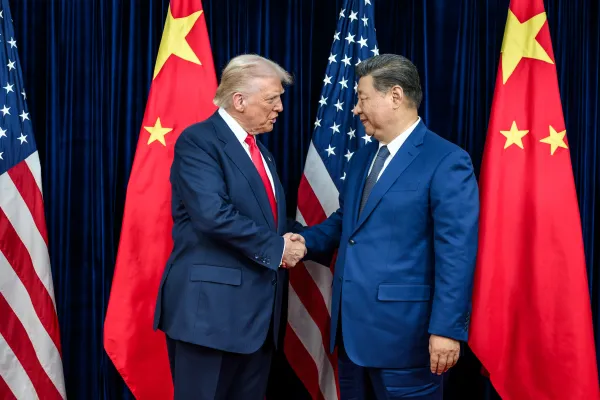
The South Korea trip was never just about Seoul; it was a crucial diplomatic stop-off on the path to an essential meeting with a different Asian leader. The diplomatic calendar was dictated by the high-stakes sideline meeting between President Trump and China’s President Xi Jinping.
Though President Trump chose to skip the main APEC leaders’ plenary session—a move that allowed President Xi to champion multilateralism—he used the summit’s framework to secure a critical bilateral understanding with Beijing.
- The Tariff Truce: In a move that calmed global markets, the two leaders agreed to a one-year US-China tariff truce, postponing the implementation of additional steep tariffs. The U.S. reduced tariffs linked to China’s role in fentanyl production from 20% to 10%.
- Rare Earths for AI Chips: A core element of the agreement was Beijing’s commitment to easing export controls on rare earth elements—critical minerals vital for U.S. defense, electric vehicle, and high-tech industries. This concession was reported to be tied to a potential relaxation of U.S. export controls on some artificial intelligence (AI) and semiconductor technology, illustrating the complex, high-tech nature of modern geopolitical negotiation.
North Korea and the Peacemaker Appeal
South Korean diplomacy, led by President Lee Jae Myung, sought to leverage Trump’s previous success in engagement.
- Re-Engagement Hopes: Lee praised Trump’s past role as a “peacemaker” and encouraged him to renew high-level dialogue with North Korean leader Kim Jong Un.
- The Status Quo: Despite the overtures, and a highly symbolic welcome ceremony where Trump was bestowed the Grand Order of Mugunghwa—South Korea’s highest civilian honor—the North Korea denuclearization Trump narrative remains stalled. While Trump expressed openness to meeting Kim again, the immediate reaction from Pyongyang was a low-key missile test, reinforcing the reality that substantive denuclearization remains a distant goal.
Conclusion: A New Era of Transactional Alliances
President Trump’s visit to South Korea for the APEC meetings was a masterclass in transactional diplomacy. It was a rapid, high-impact exchange where security assurances (nuclear subs) were traded for massive economic investment, and domestic political goals (shipbuilding jobs, tariff reduction) were achieved through bilateral deals.
The Trump South Korea visit did not simply reinforce the existing alliance; it redefined it. The US-ROK relationship is now built on clear, high-dollar-value exchanges, positioning South Korea not just as a strategic ally, but as a crucial economic partner helping to underwrite U.S. industrial and security goals.
This shift ensures the alliance is stronger and more deeply integrated than ever before, but it also raises profound questions about long-term stability and regional non-proliferation that will dominate Asian policy for years to come.
⚠️ Disclaimer
The content of this blog post is for general informational and discussion purposes only. It reflects the author’s analysis and interpretation of publicly available political and economic events. Due to the speculative nature of political analysis, the information provided may be incomplete, condensed, or contain inaccuracies. Readers should not rely solely on this content for making policy, investment, or security decisions. We make no representations or warranties of any kind, express or implied, about the completeness, accuracy, reliability, suitability, or availability of the information contained herein. Any reliance you place on such information is therefore strictly at your own risk.
About The Author