The most consequential bilateral meeting of 2025! We break down the Trump Xi Jinping meeting in Busan: the temporary Trade truce Trump Xi, the rare earth minerals China export controls pause, and the massive US soybean purchases China commitment. Expert analysis on the new US-China trade deal 2025.
For months, the global economic forecast felt like a category five hurricane watch. The two largest economies on Earth, the U.S. and China, were locked in a cycle of escalating tariffs and retaliatory trade wars that sent jitters through every boardroom from Seoul to Silicon Valley. Then, almost overnight, the storm clouds parted.
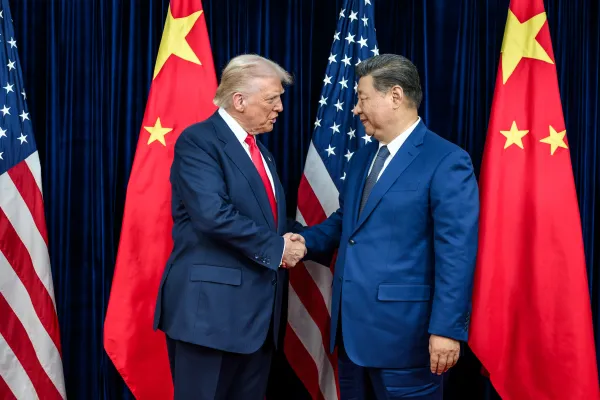
The moment came on the sidelines of the APEC Summit in Busan, South Korea. President Donald Trump and President Xi Jinping met for a crucial 100-minute bilateral session that concluded Trump’s tour of Asia. The outcome was nothing less than a significant, albeit temporary, reversal of course: the Busan summit agreement established a crucial Trade truce Trump Xi.
This deal was intensely transactional, cutting to the heart of what each leader needed most. It was a classic “I give you this, you give me that” negotiation that paused a dangerous trade escalation but left the underlying geopolitical rivalry entirely intact. Here is the full breakdown of the most significant US-China trade deal 2025 of the year.
The Core Negotiation: A Halt to the Tariff Escalation
The first, and most market-moving, outcome was the mutual agreement to step back from the brink of a full trade war. Both leaders had threatened massive, debilitating tariffs, and the world breathed a collective sigh of relief when they agreed to a pause.
The core of the economic concession centered on the existing Trump Xi tariffs cut.
The 10% Tariff Reduction and the Fentanyl Deal
The U.S. agreed to reduce a key set of tariffs it had imposed earlier this year. Specifically, the tariff rate on certain Chinese imports, primarily linked to the flow of opioid precursor chemicals, was halved from 20 percent to 10 percent.
Why this specific cut? Because it was tied to one of the administration’s most pressing domestic concerns: the opioid crisis. The reduction was directly secured in exchange for China’s commitment to significantly tighten export controls and cooperation to curb the illegal flow of chemicals used to manufacture fentanyl into North America. It brought the Fentanyl tariffs US China issue into the formal trade negotiation, demonstrating how security and trade are now inextricably linked.
Overall, this reduction lowered the aggregate U.S. tariff rate on Chinese goods from approximately 57 percent to about 47 percent. It was a meaningful, though not wholesale, concession that provided immediate economic breathing room for importers and consumers.
The Leverage Points: Minerals and Agriculture
Beyond the general tariffs, the agreement targeted two specific sectors where one nation held overwhelming leverage over the other: critical technology components and agricultural imports.
China’s Power Play: The Rare Earth Minerals Pause
One of the biggest anxieties leading into the summit was China’s recent and bold move to restrict the export of rare earth minerals China export controls. These minerals are essential components in everything from high-tech electronics and electric vehicles to advanced U.S. defense systems. With China controlling the vast majority of the world’s processing capacity, this move was a clear economic weapon.
The Trump Xi Jinping meeting resulted in a major, if temporary, victory for U.S. and allied supply chains: China agreed to suspend for one year the implementation of its expanded export controls. This included granting general licenses for the export of critical materials like rare earths, gallium, and germanium.
While Beijing framed this as a one-year pause, the White House characterized it as the “de facto removal” of the export controls. Regardless of the semantics, this concession was critical. It bought the U.S. time, time to secure supply chains through partners like Australia and Japan, and time to invest in domestic mining and processing capacity to reduce dependence on China.
The Farmers’ Victory: Massive Agricultural Purchases
On the flip side, the major concession extracted by the U.S. was a large-scale resumption of agricultural purchases. President Trump leveraged the deal to secure a massive commitment for US soybean purchases China.
China committed to purchasing at least 12 million metric tons of U.S. soybeans during the remainder of 2025, with an additional commitment to purchase at least 25 million metric tons annually for the subsequent three years. This was a huge win for American farmers, many of whom had been severely impacted by China’s earlier retaliatory tariffs and boycotts. The announcement was instantly hailed by U.S. agricultural groups, providing a powerful political narrative of the administration delivering tangible results for farm families.
U.S. Concessions and Unresolved Fundamental Issues
Of course, the Busan summit agreement required compromises from the U.S. side as well. Beyond the tariff cuts, Washington agreed to a one-year pause on an expanded export control rule (often called the “50 percent rule”) that would have automatically restricted trade with thousands of Chinese subsidiaries linked to blacklisted entities. This was a critical concession to Chinese tech firms. The U.S. also agreed to temporarily suspend new port fees imposed on Chinese vessels, another measure aimed at easing maritime trade tensions.
Despite the flurry of positive headlines and the temporary Trade truce Trump Xi, what did the leaders not solve? The answer is simple: the fundamental, long-term issues that drive the rivalry.
- Intellectual Property (IP) Theft: No breakthrough was announced on technology transfer or IP protection.
- Industrial Subsidies: China’s massive state support for its own industries (like steel and aluminum) was not addressed.
- Market Access: Deep structural concerns regarding fair competition and market access for foreign firms remain unresolved.
The deal is a crucial, high-level Band-Aid, but it is not a comprehensive peace treaty. It essentially returns the relationship to the status quo that existed before the most recent escalation, providing both sides with a valuable, but limited, one-year window of de-escalation.43
Conclusion: An Unstable Equilibrium
The Trump Xi Jinping meeting in Busan was defined by transactional genius, not ideological consensus. It succeeded brilliantly at avoiding crisis by targeting the economic pressure points that mattered most to each leader rare earth exports for China, and soybean imports and fentanyl control for the U.S.44
The result is a complex, US-China trade deal 2025 that manages antagonism rather than eliminating it. The global supply chain has been granted a reprieve, but all eyes are already looking ahead to next year. President Trump has signaled his intent to visit Beijing, with President Xi expected in the U.S. shortly after.45 These reciprocal visits will determine if this fragile agreement can be leveraged into a more durable, long-term framework, or if the two global powers will simply reset the timer on their escalating rivalry.
⚠️ Disclaimer
The content of this blog post is provided for general informational and political analysis purposes only. It reflects the author’s interpretation of publicly reported events and diplomatic statements regarding the bilateral meeting between President Trump and President Xi Jinping. Due to the high-stakes and often opaque nature of international trade and geopolitics, the information presented may be incomplete or subject to different interpretations. Readers should not rely solely on this content for making investment, policy, or security decisions. We make no warranties of any kind regarding the completeness, accuracy, or reliability of the information contained herein.
About The Author